Oxygen XML WebHelp 28 delivers a modern reading experience, versatile display modes, and new accessibility features. It focuses on making published content easier to read and navigate, with sticky table headers, Light/Dark/Auto theming, full-screen and full-width views, persistent TOC state, and a series of small but meaningful accessibility improvements. Publishers also gain more control over structure and downstream reuse through ordered-list start indices, always-visible image map areas, and an optional AI-friendly mode that produces a simplified text/Markdown view of the content for LLMs.
There are changes in:
Core
Sticky Table Headers
Table headers can now be set to stay visible as you scroll, allowing you to maintain context while viewing information. This behavior can be controlled using the new webhelp.enable.sticky.table.headers transformation parameter.
Switch Between Light and Dark Theme
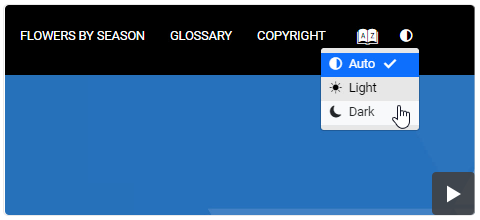
You can now let users switch between Light and Dark themes in WebHelp output by enabling the webhelp.enable.dark.mode parameter. When enabled, a Switch Theme button appears in the header, allowing users to choose between Auto, Light, and Dark modes. The Auto option adapts the interface to the browser's theme, while the Dark theme makes reading more comfortable in low light.
All embedded Oxygen Feedback components, such as Comments, Page Rating, Block-Level Comments, AI Assistant, and AI-Enhanced Search Summary, automatically match the selected theme without additional configuration.
Full Screen Mode
View WebHelp Responsive output in full screen mode by using the Enter Fullscreen/Exit Fullscreen toolbar button. This is especially helpful for large, wide screens. This behavior can be controlled using the webhelp.full.page.width parameter.
Expand Output to Full Width
WebHelp Responsive output can now be expanded to full width to accommodate large screens. A Maximize to full width/Restore to normal width button that appears in the output can be used to toggle between full width and normal width.
Expanded/Collapsed State of TOC Remains Persistent
The expanded or collapsed state of the publication TOC and the topic TOC now remain persistent as you navigate between topics in WebHelp Responsive output, making content navigation more efficient.
User Accessibility Improvements
User accessibility was further expanded for WebHelp output. Some specific improvements include the ability to select a permalink using the Tab keyboard key and open it using the Enter or Space key, screen readers are now able to read the search results rating for a searched page (the number of stars out of 5), the letters in the index terms page can also now be read, and some navigation-related accessibility issues were fixed.
Display Tooltips for Table Cells
It is now possible to enable tooltips that are displayed in WebHelp output when hovering over table cells, enhancing table readability by showing the corresponding row/column for the hovered cell. You can enable this feature by setting the webhelp.display.table.cell.tooltip parameter to "yes".
Start Ordered Lists at Certain Index
It is now possible to set the starting index of ordered lists by using the @outputclass="start-X" attribute structure, where X is the desired starting number. This offers you more flexibility when working with ordered lists.
Always Show Highlighted Image Map Areas
You can choose to keep the highlighted areas in image maps always visible by using the new webhelp.show.image.map.areas parameter. This makes it easier to work with complex image maps in WebHelp Responsive output.
Generated Text Strings Utilize New DITA-OT Unified Format
Text strings that are generated during the build process (e.g. the note label that appears before the contents of a <note> element) now utilize the new DITA-OT unified format (using <variables> as the root element), which makes customization easier and ensures consistency across plugins.
AI-Friendly WebHelp Output
You can now make your WebHelp Responsive output more accessible to AI and Large Language Models (LLMs) by enabling the webhelp.enable.ai.friendly transformation parameter. This generates a llms.txt file and companion Markdown files, giving LLMs a simplified view of your site content and a curated index of the most relevant resources.

© Copyright 2000-2026 COGITO SOFTWARE CO.,LTD. All rights reserved
